Independent health news, tests and supplement reviews.
JointVive Review (2026): Separating the Formula From the Marketing
By Arthur Vance·Retired physical therapist·Updated September 26, 2026·8 min read
Affiliate disclosure: we may earn a commission if you buy through links on this page, at no extra cost to you. It never changes what we write, and we do not sell this product ourselves. Read the full disclosure.
Quick Answer
JointVive is a liquid joint supplement built on nine plant extracts — pine bark, ginkgo biloba, bacopa, moringa, neem, tamarind and others — with no glucosamine or chondroitin anywhere in it. Several of those plants have genuine antioxidant and circulation research behind them, and the 365-day money-back guarantee is the longest we've seen on any product in this category by some distance. What we'd flag clearly: the sales material wanders into claims about the pineal gland and a "30-second Himalayan technique" that have nothing to do with joint biology, and no ingredient doses are published anywhere. The formula underneath the marketing is reasonable. The marketing on top of it is not, and you should buy knowing the difference.
Score: 3.4 out of 5.
3.4/5
Our Rating
A plausible plant-based liquid with an exceptional year-long guarantee, undermined by undisclosed doses and sales claims that reach well past what the ingredients can support.
Good fit for you if
You want a plant-based option with no glucosamine, chondroitin or shellfish-derived ingredients.
You're vegetarian or vegan and most joint products are off the table for you.
You prefer a liquid to swallowing capsules.
You want the longest possible window to decide — a full year is unusual.
Skip it if
You take blood thinners. Ginkgo biloba is a real interaction, not a theoretical one.
You take diabetes medication — moringa and neem can affect blood sugar.
Marketing claims about pineal glands and Himalayan techniques are a dealbreaker for you. Fair enough.
You need published doses before you'll spend money.
We don't sell JointVive. This link goes to the manufacturer's own website — that's where the 365-day money-back guarantee applies and where the multi-bottle pricing lives.
JointVive at a glance
Product
JointVive (liquid joint support)
Format
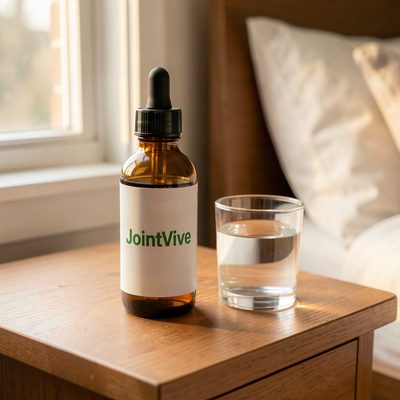
Liquid, taken by drops
Ingredients
Nine plant extracts including pine bark, ginkgo biloba, bacopa monnieri, moringa, neem, tamarind
Does NOT contain
Glucosamine, chondroitin, shellfish derivatives
Suitable for
Plant-based diets
Transparency
Ingredients named; no doses published
Time to assess
8–12 weeks
Manufacturing
Made in the USA, GMP-certified facility, third-party tested per the brand
Fully plant-based — a genuine gap-filler for vegetarians and vegans in this category.
Pine bark, ginkgo and bacopa all have real research behind them, if not always for joints.
365-day guarantee. A full year to decide is remarkable and worth real money.
Liquid format, no capsules to swallow.
No shellfish or animal-derived ingredients, so common allergy routes are avoided.
Cons
Sales material makes claims about the pineal gland that have no connection to joint function.
No ingredient doses published anywhere, so potency is unknowable.
Ginkgo biloba interacts with blood thinners. This is a real, documented interaction.
The joint-specific evidence for these particular plants is thinner than for the standard ingredients it deliberately avoids.
What Is Jointvive?
JointVive is a liquid you take in drops, built from nine plant extracts. Its defining decision is what it leaves out: there is no glucosamine, no chondroitin, and nothing shellfish-derived. That's deliberate positioning, and for a specific group of people it's genuinely useful — if you're vegetarian or vegan, or if you react to shellfish, most of the joint aisle is closed to you, and this opens it.
The mechanism the brand describes is antioxidant and circulation support rather than cartilage rebuilding. The reasoning: oxidative stress and poor microcirculation contribute to joint discomfort, so support those and the joint environment improves. That's a coherent argument and not an unreasonable one.
Now the part that we think you deserve straight. The sales material for this product also talks about the pineal gland, and promotes a "30-second Himalayan technique" for joint pain. The pineal gland produces melatonin and regulates sleep cycles. It has no role in joint function. Including it in the pitch isn't a small exaggeration — it's a claim from a different universe than the one the ingredients live in.
We're telling you that because we'd rather you evaluate the formula on its own terms. A reasonable plant blend can sit underneath unreasonable marketing; those are separate questions. What the marketing does change is how much benefit of the doubt the brand has earned on everything else it says — including the absence of any published dose.
What Is Actually In It
Pine bark extract
The strongest ingredient here. Well-studied for antioxidant activity and circulation, and it has appeared in joint-comfort research specifically. If something in this bottle is working, this is the likeliest candidate.
Ginkgo biloba
Real research base, mostly for circulation and cognitive function rather than joints. Important: ginkgo has a documented interaction with blood thinners including warfarin and aspirin. If you take anything in that family, this product requires a conversation with your doctor first. Not optional.
Bacopa monnieri
An Ayurvedic adaptogen with a solid research base — for memory and cognition. Its presence in a joint formula is a stretch, and we'd call it filler in this context rather than a mistake.
Moringa
Nutrient-dense, genuine antioxidant content, traditional use for inflammatory complaints. Plausible inclusion. Can affect blood sugar — relevant if you take diabetes medication.
Neem
Long traditional use across many complaints. Modern research is thin and scattered. Also has blood-sugar effects.
Tamarind
Antioxidant content and some research interest for joint comfort specifically. Reasonable.
The remaining ingredients
Round out the antioxidant profile without changing the overall picture.
Our honest read: pine bark and tamarind are defensible for joints. Ginkgo and bacopa are better-supported for other things entirely. With no doses published, you cannot tell whether the pine bark is at a meaningful level or present so it can appear on the label. That's the core weakness, and the long guarantee is the brand's answer to it.
What we checked
What we did: checked each of the nine plants against published research, specifically asking whether the evidence relates to joints or to something else — a distinction that matters a lot here. Read the sales material carefully to separate ingredient claims from mechanism claims. Read the 365-day refund terms in full. Pulled buyer feedback from independent platforms and open discussion.
What we did not do: run a trial, or present a personal recovery story.
Where we landed: a plausible plant blend with an outstanding guarantee and marketing that has not earned your trust. Those can all be true at once.
What buyers actually report
Positive themes: people describe gradual improvement in stiffness and general ease of movement, typically after several weeks. A recurring secondary theme is the format — people who dislike swallowing capsules find a liquid genuinely easier to keep up with, and consistency is most of the battle in this category.
Negative themes: a substantial share report no change, which is expected for a formula with no disclosed dosing. Price comes up frequently relative to what's actually in the bottle. And a specific frustration worth flagging: some buyers describe being confused by the refund process despite the long window. A year-long guarantee is only worth what the process behind it delivers — keep your order confirmation email, and note the refund contact details that arrive with the product.
The fair conclusion: modest and inconsistent results, a format people genuinely stick with, and a guarantee that is the main reason to consider it at all.
How To Take It
Follow the label dose — this is taken as drops, typically once daily. Same time every day; consistency is worth more than timing.
Eight to twelve weeks before judging. As with every product in this category, write down a 1-to-10 on morning stiffness, same time each day, because joint symptoms drift with weather and activity and memory is a poor instrument.
Here's a practical note specific to this product: you have a full year. Use it properly. Run it for three months. If nothing changed, request the refund — don't let a year-long window become a year of paying for something that isn't doing anything because the deadline felt far away. Long guarantees work on exactly that psychology.
Who Should Buy It
Buy it if you're vegetarian or vegan, or react to shellfish, and the standard joint aisle is closed to you — that's the clearest case for this product. Buy it if you prefer liquids and know you won't keep up with capsules. And buy it if the year-long window is what makes you willing to try anything at all.
Don't buy it if you take blood thinners without clearing the ginkgo with your doctor, or diabetes medication without clearing the moringa and neem. Don't buy it if you want the best-evidenced joint ingredients — you're deliberately paying to avoid those. And don't buy it if marketing that invokes the pineal gland is a dealbreaker. That's a completely reasonable line to draw.
Price, Guarantee, Where To Buy
Sold through the manufacturer's site only. Tiered pricing — single bottle highest per bottle, multi-bottle bundles lower, usually with free shipping on the larger ones. Check the current tiers on the site.
The 365-day money-back guarantee is the headline term and the single best reason to consider this over a better-evidenced competitor. A full year means you can run a proper three-month trial, wait, try again in a different season, and still get your money back.
Two practical notes. Keep your order confirmation email — you'll need the order ID. And set a calendar reminder for month four, not month eleven, so you make the decision on evidence rather than on a deadline.
JointVive occupies a real gap: a fully plant-based joint supplement with nothing animal-derived, in a liquid format, for people the rest of this category effectively excludes. Pine bark and tamarind are defensible choices, and the year-long guarantee is the longest we've encountered anywhere in this space. What holds it back is honest to say: no published doses, several ingredients that are better-supported for things other than joints, and sales material that reaches into claims — the pineal gland, a Himalayan technique — that have nothing to do with joint biology. We don't think that makes the product worthless. We do think it means the brand hasn't earned the benefit of the doubt, and you should go in accordingly.
Buy it if you're plant-based or shellfish-sensitive and want a genuine option, and the year-long window is what makes it worth trying.
We don't sell it — this is the manufacturer's own site, where the 365-day guarantee and the multi-bottle pricing live.
Frequently asked questions
Is JointVive a scam?
No. It's a real product with a real refund policy and named ingredients. Some of its marketing claims are not supportable, which is a different criticism and one we'd take seriously.
Does the pineal gland have anything to do with joints?
No. The pineal gland produces melatonin and regulates sleep cycles. Its appearance in the sales material is a marketing claim, not biology.
Is it vegan?
It's plant-based with no shellfish or animal-derived ingredients — its clearest genuine advantage. Confirm the capsule-free liquid base on the current label if you're strict.
Does it contain glucosamine?
No, deliberately. That's the positioning. Whether that's a feature or a drawback depends on whether glucosamine has ever worked for you.
Can I take it with blood thinners?
Ask your doctor first. Ginkgo biloba has a documented interaction with warfarin and aspirin. This is the most important safety note on this page.
Can I take it with diabetes medication?
Ask your doctor. Moringa and neem can both affect blood sugar.
How long until I'd know?
Eight to twelve weeks. Decide by month four so you're not drifting toward the deadline.
What are the doses?
Not published. That's a real limitation and you should weigh it.
How do I claim the 365-day refund?
Through the contact details supplied with the product. Keep your order confirmation email and order ID — some buyers report friction without them.
Is it on Amazon?
Sold through the manufacturer's site. Marketplace listings won't carry the guarantee.
Is it a subscription?
The tiers are one-time purchases. Check your order summary at checkout.
Affiliate disclosure: If you buy through the links on this page we may earn a commission, at no extra cost to you. This never changes what we write, and we do not sell this product. Read the full disclosure.
This review is for information only and is not medical advice. Talk to your doctor before starting this supplement if you take blood thinners, diabetes medication or any other prescription, or if you are pregnant or nursing. Joint pain that is new, sudden, sharply localised, or accompanied by swelling, redness or heat should be assessed by a doctor. These statements have not been evaluated by the Food and Drug Administration. This product is not intended to diagnose, treat, cure or prevent any disease.